
How to Choose Rake and Trail for a Custom Chopper Build

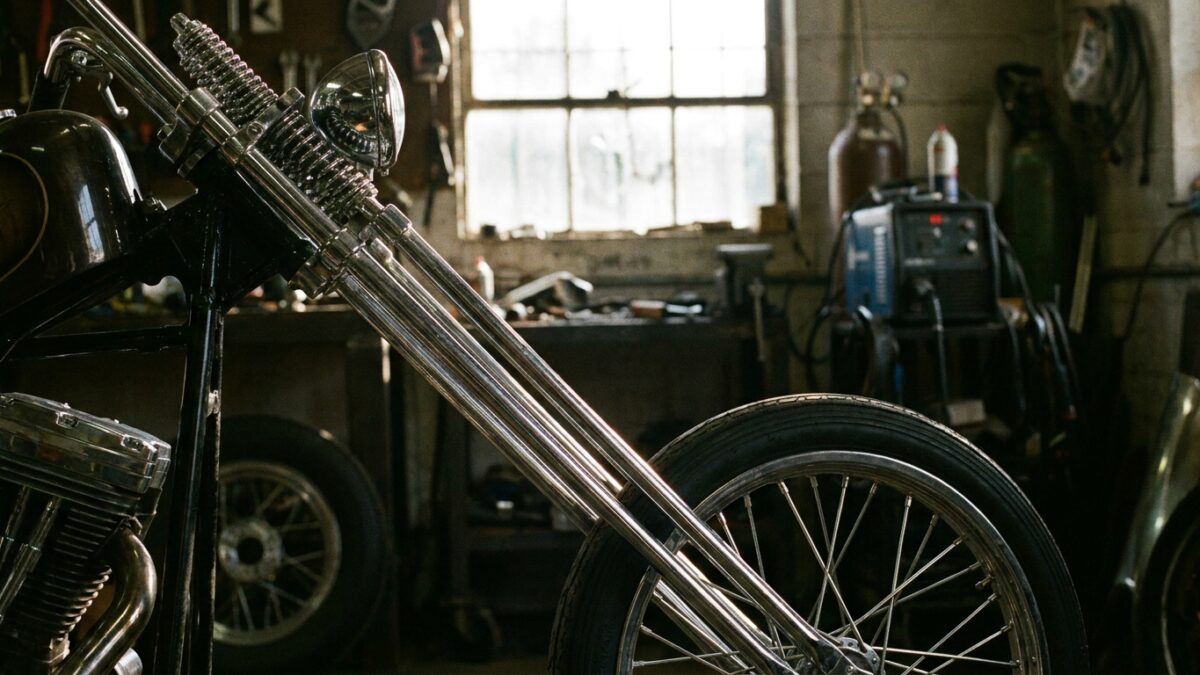
Rake and trail form the foundation of how a chopper handles. Get the numbers wrong and the bike becomes either dangerously twitchy or impossibly heavy to steer. Get them right and even a long frontend delivers stability without turning every parking lot into a struggle. Understanding these measurements means building a chopper that rides instead of one that sits.
Rake refers to the angle of the steering head, measured from vertical. A stock cruiser might run 28 to 32 degrees. Choppers push that number higher, often into the mid-thirties or low forties. More rake tilts the front wheel forward, stretching the wheelbase and creating that signature chopper stance. Trail measures the distance between where the front tire contacts the ground and where an imaginary line through the steering head would hit the pavement. This offset creates the self-centering force that keeps the bike tracking straight.
How Rake and Trail Work Together
Rake and trail do not operate independently. Increasing rake without adjusting other variables reduces trail, making steering quicker but less stable. Adding fork length increases trail, which slows steering response but improves straight-line stability. A chopper with 38 degrees of rake and short forks might feel nervous and prone to wobble. The same rake with extended forks can deliver smooth highway manners.
Trail typically ranges from three to six inches on choppers. Less than three inches creates a bike that oversteers, darting with every road imperfection. More than six inches builds in so much stability that low-speed maneuvering becomes exhausting. The right number depends on intended use, rider weight, and tire choice.
Wheel diameter affects trail directly. A larger front wheel increases trail even when rake and fork length stay constant. Switching from a 19-inch to a 21-inch front wheel adds roughly half an inch of trail. Tire width matters too. A wide front tire reduces effective trail because the contact patch moves forward, shortening the mechanical trail that governs handling.
Starting Points for Different Chopper Styles
Old-school choppers with moderate stretch run well with 35 to 38 degrees of rake and four to five inches of trail. This combination delivers classic chopper looks without requiring arm strength to U-turn. Forks extend six to ten inches over stock, and a 21-inch front wheel keeps proportions balanced.
Radical choppers with extreme rake push into 40 to 45 degrees. These builds need longer forks and careful trail calculation to remain rideable. Trail should stay above four inches, which often means forks extending twelve inches or more. Anything less creates a bike that weaves under power and feels unstable above 50 mph.
Digger-style choppers with steep rake but short forks require different math. Rake might hit 42 degrees, but shorter forks and a smaller front wheel keep trail in the four-inch range. These bikes turn sharply but demand smooth roads. Rough pavement sends constant feedback through the bars.
Calculating Trail Before Cutting Metal
Trail calculation involves rake angle, fork length, wheel diameter, and axle offset. Online calculators handle the trigonometry, but understanding the inputs matters more than the formula. Measure rake from true vertical, not from the frame’s angle when the bike sits on the sidestand. Small errors here multiply through the calculation.
Fork length means the full extended measurement from axle center to the bottom of the triple tree. This number includes any internal components that affect axle position. Aftermarket triple trees with built-in rake add degrees beyond what the frame provides, requiring adjustment in the calculation.
Axle offset refers to how far forward the axle sits relative to the fork tubes. Most chopper forks use zero offset, placing the axle directly between the tubes. Offset changes trail without altering rake or fork length, offering fine-tuning after the basic geometry is set.
Testing and Adjusting Trail
Numbers predict behavior, but riding reveals truth. A rolling chassis allows testing before final assembly. The bike should track straight with hands off the bars at moderate speed. Light bar pressure should initiate turns without fighting back. Heavy pressure or vague response indicates trail problems.
Adding or removing fork length changes trail approximately one inch per six inches of fork tube, depending on rake angle. Steeper rake makes this ratio less direct. Swapping wheels offers another adjustment path. Moving from a 21-inch to a 23-inch front wheel adds trail. Dropping to a 19-inch wheel reduces it.
Triple tree rake provides a bolt-on solution when frame rake is fixed. Trees with five degrees of additional rake steepen the steering head angle without frame modification. This increases rake but reduces trail unless fork length compensates. Conversely, trees with negative rake can recover trail on a frame with excessive rake.
Common Mistakes That Ruin Handling
Prioritizing appearance over geometry produces bikes that look right but ride wrong. Extended forks that match a desired visual often deliver too much or too little trail. Building backward from a stance goal instead of a handling target creates problems that become obvious on the first ride.
Ignoring tire size leads to trail surprises. A builder calculates trail with a 21-inch wheel, then fits a 23-inch wheel for aesthetics. The extra diameter adds trail, slowing steering beyond what the geometry intended. The opposite happens when a wide front tire goes on without recalculating effective trail.
Mixing rake sources without accounting for total angle causes confusion. A frame with 35 degrees of rake plus a triple tree with five degrees of additional rake equals 40 degrees total. Calculating trail using only the frame rake number produces wrong results and incorrect fork length.
Real-World Riding Priorities
A chopper built for highway miles benefits from more trail and stability. Four and a half to five and a half inches of trail keeps the bike composed at speed and reduces rider fatigue. Slower steering matters less when most turns happen at 60 mph with gradual curves.
Urban choppers need sharper handling and easier parking. Three and a half to four and a half inches of trail allows tighter turns without arm wrestling the bars. Stability suffers slightly, but city speeds rarely expose the compromise. Shorter wheelbase and moderate rake support this approach.
Show bikes exempt from street duty can ignore practical limits, but most builders eventually want to ride what they build. Keeping rake under 42 degrees and trail above three and a half inches maintains a connection to functional geometry. Extreme numbers look dramatic in photos but punish riders over distance.
Rake and trail define how a chopper behaves in every situation from parking to passing. Choosing these numbers based on intended use rather than appearance alone separates rideable customs from static sculptures. Calculating before building and testing before finalizing delivers a chopper that handles as well as it looks.