
Winter Storage That Does Not Wreck a Carburetted Engine

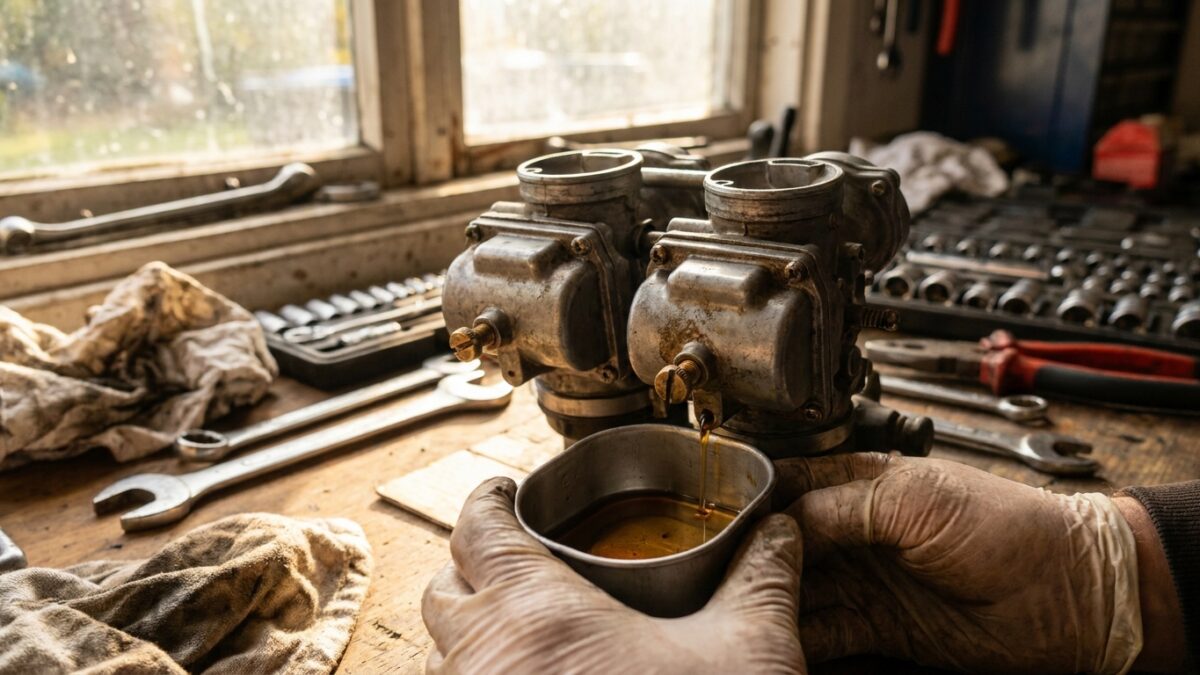
Storing a carbureted motorcycle through winter requires more deliberate preparation than parking a fuel-injected machine. Carburetors lack the sealed precision of electronic fuel delivery. Their brass jets, floats, and passages sit exposed to whatever fuel remains inside them. When that fuel degrades, the carburetor suffers. When moisture enters the cylinders, the engine pays.
The damage appears gradually. Varnish clogs jets too small to see clearly. Corrosion pits aluminum castings. Rings stick to cylinder walls. What seems like cautious storage becomes expensive repair if the fundamental steps get skipped or rushed.
Fuel Stabilization or Complete Removal
Two opposing schools handle fuel differently. One drains every drop. The other fills the tank completely and adds stabilizer. Both work when executed properly. Neither works halfway.
Complete drainage prevents all fuel-related deterioration. The tank, petcock, fuel line, and carburetors get emptied. The engine runs until it dies from fuel starvation, confirming the float bowls sit dry. This method eliminates varnish risk entirely but exposes bare metal inside the tank to moisture and potential rust. It works best for tanks with quality internal coatings or stainless construction.
Full tank storage with stabilizer does the opposite. The tank gets filled to the brim, eliminating airspace where condensation forms. Quality fuel stabilizer enters the tank at the correct ratio, usually one ounce per two and a half gallons. The engine then runs for five minutes, circulating treated fuel through the entire system including the carburetors. The stabilizer prevents oxidation and varnish formation for six months or longer depending on the product.
Half measures fail. A partially filled tank provides maximum surface area for condensation. Stabilizer added without running the engine never reaches the carburetors. Draining the tank but leaving fuel in the bowls concentrates the varnish problem exactly where it causes the most damage.
Carburetor Float Bowl Drainage
Most carburetors include drain screws on the float bowls. These brass screws sit at the lowest point of the bowl, designed specifically for storage preparation. Opening them fully drains residual fuel even after the tank empties.
The process requires a container beneath each carburetor and something absorbent for spills. Loosen each drain screw two full turns. Fuel flows immediately. When flow stops, close the screw finger-tight. Overtightening cracks the soft brass sealing surface.
Carburetors without drain screws require different approaches. Some designs allow float bowl removal with two or four screws. Others need the entire carburetor removed from the engine. The float bowl comes off, gets cleaned, and reinstalls dry. This method takes longer but guarantees no fuel remains.
Leaving fuel in float bowls through winter creates the varnish buildup that prevents engines from starting in spring. The idle jets clog first because they meter the smallest fuel passages. Main jets follow. By the time an engine finally fires after sitting on varnished fuel, the carburetor needs complete disassembly and ultrasonic cleaning or replacement jets.
Cylinder Protection Through Fogging
Empty cylinders corrode when humid air reaches bare metal. Fogging oil prevents this by coating cylinder walls, valves, and piston crowns with protective film. The process takes ten minutes and saves cylinder honing or worse.
Remove the air filter or air box to access the carburetor intake. With the engine running at idle, spray fogging oil directly into each carburetor throat in two or three second bursts. The engine smokes heavily as the oil burns. Continue until the engine begins to stumble from oil richness, then immediately shut off the ignition while still spraying. This final burst coats everything as the engine stops.
The alternative method removes the spark plugs and sprays fogging oil directly into each cylinder. Rotate the engine by hand several times to distribute the oil across the cylinder walls. Replace the plugs finger-tight. This approach works better for engines that do not run or cannot run before storage.
Engines stored without fogging develop surface rust on cylinder walls within weeks in humid climates. The rust appears as orange dust on a finger wiped inside the spark plug hole. Once present, it scores the rings every time the engine turns. Light surface rust hones out. Deep pitting requires cylinder boring and oversize pistons.
Oil Change Timing
Used oil contains combustion acids, fuel contamination, and moisture. Storing an engine on used oil lets these contaminants attack bearings and cylinder walls without interruption. Fresh oil provides clean protection.
Change oil and filter immediately before storage, not after. The old oil comes out hot, carrying more contaminants with it. The new oil goes in clean and runs for five minutes to circulate through the engine. This fresh oil sits in contact with all internal surfaces through the storage period, preventing corrosion.
Some mechanics argue for changing oil after storage to remove condensation that accumulated during winter. This approach leaves an engine sitting for months on contaminated oil to save one oil change. The bearing wear and acid etching cost more than the oil saved.
Battery Maintenance
A battery left connected through winter slowly drains from parasitic draws in the electrical system. A battery stored fully discharged sulfates permanently. Both scenarios end in replacement.
Disconnect the negative cable first, then the positive. Remove the battery from the motorcycle and store it somewhere temperature-stable. Concrete floors do not drain batteries despite persistent myth, but temperature swings do.
A float charger or battery tender maintains charge without overcharging. These devices monitor battery voltage and apply current only when needed. They connect for the entire storage period. Batteries stored without charging need monthly voltage checks and periodic recharging when voltage drops below twelve and a half volts.
Environmental Protection
Where the motorcycle sits matters as much as how it sits. Indoor storage prevents the majority of weather-related damage. A garage or shed with consistent temperature beats a covered outdoor space. Concrete floors work fine with a barrier beneath the tires to prevent moisture wicking.
Motorcycle covers trap moisture unless the bike sits completely dry before covering. A cover over a wet motorcycle creates a humid microclimate that accelerates corrosion. If a cover gets used, ensure the exhaust pipes cool completely and any wash water evaporates fully first.
Tire pressure increases slightly before storage to prevent flat spotting. Fifteen percent over normal pressure compensates for the slow loss that occurs over months. Center stands remove weight from tires entirely. Paddock stands work similarly. Motorcycles without stands benefit from moving slightly every few weeks to rotate the contact patch.
Spring Recommissioning
Proper storage makes spring startup simple. Reconnect the battery. If fuel was stabilized, confirm the petcock opens and fuel flows. If fuel was drained, refill the tank with fresh gas and allow time for the carburetors to fill. Check tire pressure. Pull the plugs and rotate the engine by hand to verify free movement and confirm fogging oil distributed properly. Reinstall the plugs.
The engine should fire within a few kicks or cranks. Initial smoke from fogging oil clears within thirty seconds. Idle may hunt slightly until fresh fuel completely displaces stabilized fuel in the jets. A short test ride confirms everything functions.
Motorcycles stored incorrectly reveal themselves immediately. Hard starting, rough idle, and hesitation all point to varnished jets. Difficult cranking suggests cylinder or ring problems from corrosion. A dead battery or one that will not hold charge indicates sulfation from deep discharge. Each problem traces directly back to a skipped preparation step.
Carbureted engines reward careful storage with reliable spring performance. The work happens in fall, not spring. Thirty minutes of deliberate preparation prevents days of frustration and carburetor rebuilds when riding season returns.