
What Examiners Actually Test During Your Motorcycle Road Exam

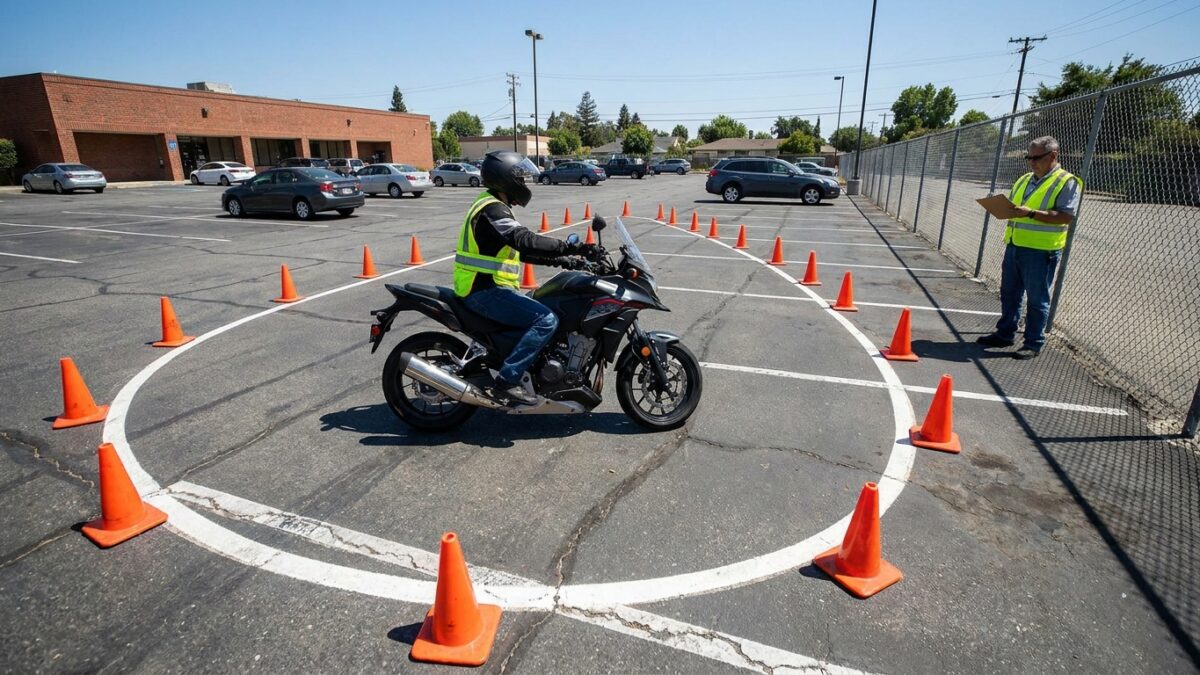
The motorcycle road exam stands between a learner’s permit and full riding privileges in every state. While written tests measure knowledge of traffic laws and motorcycle operation, the road test evaluates whether a rider can execute fundamental skills under observation. Examiners score specific maneuvers that represent broader categories of motorcycle control and hazard awareness.
Most state licensing agencies structure their road tests around five core competency areas. These categories remain consistent across jurisdictions, though the specific exercises and scoring criteria vary by state.
Starting, Stopping and Balance Control
Examiners begin assessment before the motorcycle moves. Starting procedures reveal whether a rider understands pre-ride checks and safe launch techniques. The examiner watches for proper clutch engagement, throttle modulation, and stability when moving from a standstill.
Controlled stops test progressive braking and balance maintenance. Most tests require both normal stops and quick stops from specified speeds. A normal stop demonstrates smooth application of both brakes without locking either wheel. The quick stop simulates emergency braking, typically from 20 miles per hour, with scoring based on stopping distance and control maintenance.
Balance at low speed appears in nearly every road test. Riders navigate a straight line or box pattern at walking speed, demonstrating clutch and throttle coordination. The exercise simulates parking lot maneuvering and slow-speed traffic situations where many crashes occur.
Cornering and Lean Angle Management
Turning exercises evaluate body position, vision, and throttle control through curves. Examiners set up cones or mark pavement to create turns of varying radii. Riders must complete these turns within lane boundaries while maintaining steady speed.
The examiner watches head and eye position. Proper technique requires looking through the turn toward the exit, not down at the pavement or at the inside boundary. Throttle application should be smooth and steady through the arc. Abrupt changes in speed or jerky inputs indicate poor control.
U-turns or tight radius turns appear on most tests. These maneuvers require maximum lean angle at minimum speed. Riders must complete the turn within a marked area, typically two parking spaces wide, without touching feet to the ground or crossing boundary lines. This exercise combines balance, vision, throttle control, and lean angle judgment.
Swerving and Obstacle Avoidance
The swerve test simulates avoiding a hazard that appears suddenly in the travel lane. Examiners mark a lane with cones creating a straight approach, an offset section, and a straight exit. Riders accelerate to a specified speed, then shift quickly from one side of the lane to the other without braking.
Successful swerving requires countersteering rather than handlebar turning. The motorcycle must change direction quickly while maintaining speed and control. Hitting cones, braking during the maneuver, or crossing lane boundaries results in point deductions or test failure.
Some states include a weave test where riders navigate a slalom pattern through multiple cones. This exercise evaluates the same countersteering skills in a slower, more controlled setting.
Shifting and Throttle Management
Gear selection and smooth shifting appear throughout the road test. Examiners listen for engine lugging, excessive revving, or grinding during shifts. Proper technique matches engine speed to road speed in each gear without mechanical stress.
Downshifting receives particular attention. Riders must reduce gears when slowing for turns or stops, maintaining appropriate engine braking. Skipping multiple gears or coasting in neutral indicates poor throttle management.
Throttle control affects nearly every scored maneuver. Jerky acceleration, abrupt deceleration, or unsteady speed in turns all indicate inadequate throttle modulation. Examiners distinguish between deliberate control inputs and reactive corrections.
Traffic Interaction and Situational Awareness
Road tests conducted in traffic rather than on closed courses add evaluation of real-world riding decisions. Examiners score lane positioning, following distance, intersection approach, and merge execution.
Proper lane position places the motorcycle in the tire track that provides best visibility and escape routes. This position changes based on traffic, road conditions, and potential hazards. Riding in the center of the lane or hugging either edge without tactical reason shows poor positioning judgment.
Following distance must account for motorcycle stopping capabilities and visibility to other drivers. The two-second rule applies as a minimum, with greater distance appropriate for conditions. Tailgating or allowing other vehicles to compress following distance both indicate awareness problems.
Head checks before lane changes and turns demonstrate active scanning rather than mirror reliance alone. Examiners watch for deliberate head movement to check blind spots. Missing a head check typically results in immediate test failure in states that score this element.
Common Failure Points and Scoring Systems
Most road tests use point deduction systems. Riders begin with a perfect score and lose points for errors. Minor mistakes like slightly wide turns or momentary speed variations cost fewer points than critical errors such as dropping the motorcycle or running stop signs.
Automatic failures exist for dangerous actions regardless of points accumulated. These typically include crashing, causing other vehicles to take evasive action, running traffic controls, exceeding speed limits by specified margins, or refusing to attempt required maneuvers.
Foot-down failures trip up many riders on low-speed exercises. Touching a foot to the ground for balance during turns, U-turns, or slow-speed boxes usually results in point loss or automatic failure depending on state standards. Examiners distinguish between a quick toe-touch for balance and putting weight on a foot or using it to paddle.
Passing scores vary by state, with most requiring 70 to 80 percent of total points. A rider can make multiple small errors and still pass, but any combination of mistakes that drops the score below the threshold means retesting.
Preparation Beyond Memorization
Road test exercises represent fundamental motorcycle control skills required for safe riding. The test environment provides controlled evaluation of abilities riders need every time they ride.
Effective preparation involves practicing the specific exercises under test conditions, but more importantly developing the underlying skills those exercises measure. A rider who can swerve smoothly around cones at 20 miles per hour has the muscle memory to avoid a car door that opens unexpectedly. Someone who masters U-turns in a parking lot can confidently navigate tight mountain switchbacks.
Examiners evaluate whether riders demonstrate consistent control and appropriate responses to standard situations. The road test checks fundamental competency, not advanced skill. Passing means a rider has shown baseline ability to operate a motorcycle safely in common circumstances. What happens after that depends on continued practice and judgment development that no single test can measure.