
What Motorcycle Road Tests Actually Evaluate During Licensing

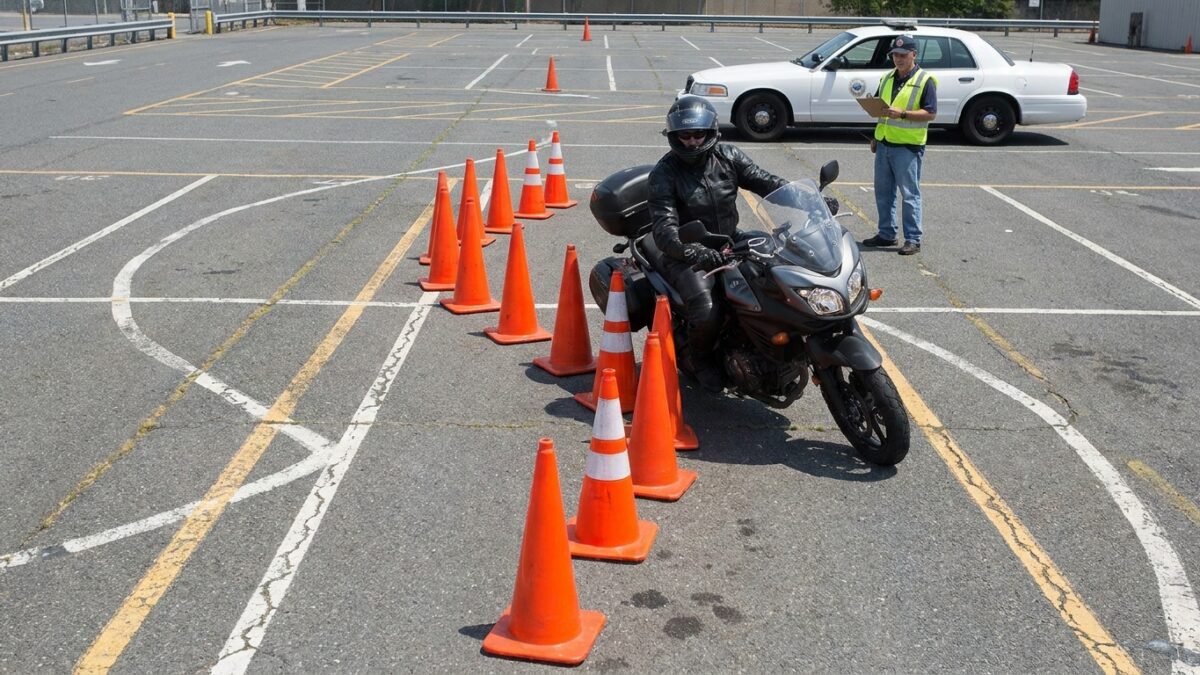
The motorcycle road test remains the final barrier between a learner’s permit and full riding privileges. While many riders focus on memorizing the written exam, the practical evaluation measures competencies that determine real-world survivability. Examiners follow standardized scoring rubrics, but the underlying skills being assessed go deeper than simply completing a cone weave or emergency stop.
Control Zone Evaluation: Low-Speed Maneuvering
Most endorsement tests begin in a controlled area before riders enter traffic. This section evaluates fundamental machine control at speeds where many riders struggle most. The slow-speed maneuvers reveal whether a rider has developed the friction zone finesse and counterbalance techniques necessary for parking lots, u-turns, and stop-and-go traffic.
The cone weave specifically checks handlebar input smoothness and throttle modulation. Examiners watch for abrupt steering corrections, feet touching down, or crossed cones. What they’re really measuring is whether the rider can maintain stability through weight transfer and controlled power delivery rather than aggressive handlebar sawing. A smooth weave demonstrates the rider understands the motorcycle follows the eyes and responds to subtle inputs.
Box turns and figure-eight patterns assess the same principles with added complexity. Riders must maintain constant speed while leaning the motorcycle through tight arcs. The common failure point involves chopping the throttle mid-turn, which stands the bike up and sends it wide. Examiners specifically note whether riders keep steady power through the entire maneuver, indicating they’ve internalized the relationship between throttle, lean angle, and turning radius.
Emergency Braking: Threshold and Control
The emergency stop test measures whether riders can deploy maximum braking force without locking either wheel. From a specified speed, riders must brake within a marked distance while maintaining control and keeping the motorcycle upright. This single exercise evaluates multiple critical skills simultaneously.
Examiners watch the brake application technique closely. Progressive pressure on both levers demonstrates proper training. Grabbing a fistful of front brake typically results in immediate failure through wheel lockup or loss of control. The test also reveals whether riders have developed the muscle memory to use both brakes appropriately. Many newer riders over-rely on the rear brake, resulting in longer stopping distances that exceed the marked zone.
The less obvious element being evaluated is body position during hard braking. Riders who remain loose and centered can modulate brake pressure at the threshold of traction. Those who tense up or shift weight dramatically often trigger instability. Examiners note riders who maintain vision forward rather than fixating on the stop line, which indicates proper target fixation habits.
Intersection Navigation and Decision Making
Once riders enter the road portion of the test, examiners shift focus from mechanical skills to judgment and awareness. Intersections provide the richest evaluation environment because they require integrated decision-making under pressure. The examiner isn’t just checking whether the rider stops at red lights, but how they process multiple information streams simultaneously.
Approach speed to intersections reveals risk assessment skills. Riders who maintain excessive speed until the last moment, then brake hard, demonstrate poor planning. Those who begin rolling off throttle early and cover the brake lever show anticipatory habits. Examiners specifically watch for brake light activation during approach, which indicates the rider is preparing for potential hazards even when the light remains green.
Head movement becomes crucial during intersection evaluation. Examiners need to see obvious left-right scanning before proceeding through any junction. This isn’t performative theater. The test measures whether riders have developed the systematic scanning pattern necessary to detect cross-traffic, pedestrians, and red-light runners. Riders who proceed through intersections with minimal head movement typically fail this section regardless of their mechanical skills.
Gap selection during left turns across traffic tests judgment under real conditions. Examiners watch whether riders choose appropriate openings or force their way into insufficient gaps. Equally important is what happens after the rider commits to the turn. Smooth acceleration through the intersection while maintaining lane position demonstrates integrated skills. Hesitation mid-turn or drifting into adjacent lanes suggests incomplete mastery.
Lane Positioning and Space Management
Throughout the road test, examiners continuously evaluate lane positioning choices. Motorcycles require different spatial strategies than cars, and endorsement tests specifically check whether riders understand these principles. Simply staying between the lines isn’t sufficient.
The blocking position in the left tire track discourages cars from sharing the lane and maximizes visibility to oncoming traffic during left turns. Examiners watch whether riders instinctively move to this position when appropriate. Similarly, the right tire track becomes optimal when avoiding roadside debris or preparing for right turns. Random wandering within the lane or consistently riding the center strip indicates the rider hasn’t developed strategic positioning habits.
Following distance receives particular attention. Examiners expect riders to maintain greater spacing than typical car drivers use. The standard two-second minimum extends to three or four seconds during adverse conditions. Riders who tailgate or allow themselves to be pressured into closing gaps by impatient traffic behind them demonstrate poor risk management.
Mirror Usage and Environmental Awareness
Examiners track mirror check frequency throughout the road test. Riders should visibly check mirrors before every lane change, turn, or significant speed adjustment. The evaluation goes beyond simple mirror glances, though. Examiners want to see head checks over the shoulder before lane changes, proving the rider understands motorcycles have larger blind spots than cars.
Environmental scanning separates competent riders from those likely to experience incidents. Examiners watch eye movement to ensure riders are processing the full visual field rather than target fixating on the vehicle directly ahead. Riders who identify and react to potential hazards before they develop—a car in a driveway preparing to back out, a pedestrian at a crosswalk, debris in the roadway—demonstrate the threat recognition skills necessary for independent riding.
Speed Management and Flow Integration
Maintaining appropriate speed requires constant adjustment based on conditions, traffic flow, and road characteristics. Examiners expect riders to match traffic speed within legal limits. Riding significantly below the speed limit creates hazards just as speeding does. The test measures whether riders can integrate smoothly into traffic rather than becoming obstacles.
Throttle control smoothness appears throughout the evaluation. Jerky acceleration or abrupt deceleration indicates incomplete clutch and throttle coordination. Examiners listen for engine lugging or excessive revving, both suggesting the rider hasn’t developed proper gear selection instincts. Smooth power delivery through curves, particularly when combined with proper vision and lane positioning, demonstrates integrated riding skills.
Turn Execution and Cornering Lines
Every turn during the road test provides data about the rider’s cornering technique. Examiners evaluate the entire process from approach through exit. Proper technique involves slowing to appropriate entry speed before the turn, establishing lean angle smoothly, maintaining steady or slightly increasing throttle through the apex, and accelerating gently on exit.
Common failure patterns include braking mid-turn, which destabilizes the motorcycle and can cause lowside crashes. Riders who enter turns too fast, then chop throttle or grab brake, demonstrate dangerous habits. The correct response to excessive entry speed involves looking through the turn and leaning farther, but many inexperienced riders fixate on perceived obstacles and target fixate into them.
Lane discipline during turns separates trained riders from those who’ve simply picked up bad habits. Drifting wide into opposing traffic lanes or onto road shoulders indicates poor turn planning. Examiners specifically watch whether riders establish proper entry positioning, apex at the optimal point, and exit with controlled acceleration while maintaining lane position.
What Automatic Failures Mean
Certain actions during road tests result in immediate failure regardless of performance in other areas. These critical errors include dropping the motorcycle, causing other vehicles to brake or swerve, running red lights or stop signs, exceeding posted speed limits by significant margins, or losing control during any maneuver.
Less obvious automatic failures involve riding into oncoming traffic lanes, even briefly, or making turns from incorrect lanes. These errors demonstrate fundamental judgment problems that endanger the rider and others. Examiners have no discretion to overlook such mistakes regardless of how well the rider performs otherwise.
The endorsement test ultimately measures whether riders have developed sufficient skills and judgment to operate independently without creating undue risk. The specific maneuvers and routes vary by jurisdiction, but the underlying competencies being evaluated remain consistent. Riders who understand what examiners are actually checking can prepare more effectively than those who simply practice the visible maneuvers without grasping the principles being assessed.